
Whether it’s for a wedding, a special function or festival at home buying a kanchipuram silk saree is a dream for every Indian woman. We’re talking about traditional value and the money invested for a pure kanchipuram silk saree. But with so many imitations floating around, how do you really know if the saree you’re holding is a original kanchipuram silk saree?
Good news: once you know what to look for, it’s not that hard to identify a genuine Kanchipuram silk saree. Here’s how you can become a confident buyer and make sure that what you spend is totally worth it.
1. Feel the fabric – a kanchipuram silk saree should speak luxury
The first thing you’ll notice with pure Kanchipuram silk is the texture. It feels rich, smooth, and slightly heavy. That weight comes from the quality of silk threads used—and from the zari (more on that in a second).
Semi silk sarees may feel rough, too light, or overly shiny (like plastic). Real silk has a natural sheen that’s elegant, not blinding and looks subtle.
Did you know – kanchipuram silks are woven from mulberry silk where two or three strands are twisted together to form a single yarn which gives the name murukku pattu to pure kanchipuram silk sarees? This gives the density to kanchipuram silk sarees.

2. The zari test – Is It real gold or just foil?
Zari is what gives Kanchipuram sarees their royal look. It is the main factor which determines the cost of a kanchipuram silk saree. Pure zari kanchipuram silk sarees are made from zari which consists of silver threads dipped in gold.
Essentially pure zari is 3G or 4G zari where the silver content is 30 to 40 %. To explain precisely, 1kg of pure zari contains 30-40% silver content in it which is only deemed as pure zari. Many Kanchi silks are woven in 2G which does not have much silver content and there is absolutely no gold content here.
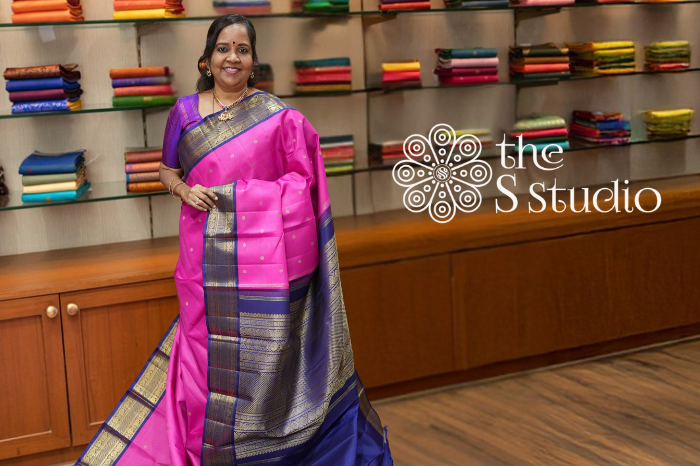
There is no fool proof method to test the purity of zari at home. But the government authorised testing centre at kanchipuram has testing mechanism to certify the authenticity of zari at a nominal cost. Choose to buy Kanchipuram silk sarees from known shops or boutiques who mention the purity of zari clearly like The S studio, Chennai.
Did you know - In ancient days kanchipuram silk sarees were woven with 5G zari also which is very rare to find nowadays.

3. Check the border & body joint in a kanchipuram silk saree – this is the signature korvai technique
One of the most iconic features of a Kanchipuram silk saree is the way the body and border are woven interlocked. This method is called korvai and it’s a strong indicator of authenticity. A korvai border kanchipuram silk saree is one of the ancient types of weaving a kanchipuram silk saree which is becoming rare to find nowadays as the weavers of this special technique are now hard to find !
In a genuine Kanchi pattu saree, you’ll see tiny zig-zag lines which are not very straight. The body and border are joined in korvai in a traditional kanchipuram silk saree which gives it the authentic look of a original. That’s the magic of korvai border kanchipuram silk sarees.
Tip: Look closely, if the border looks like it's stitched or stuck on, it’s not real.

4. Look at the motifs in a pure kanchipuram silk saree – are they traditional?
Kanchipuram designs are rooted in temple art and South Indian culture. You’ll often see motifs like:
- Peacocks, annams
- Rudraksha beads
- Checks and stripes
- Temple borders
- Yazhi, the mythical creature with lion or elephant head
- Ganda berunda
- Mango (paisley) designs
Modern versions may have newer patterns, but a pure Kanchipuram always carries that traditional aesthetic.

5. Ask for the silk mark for authenticity of a pure kanchipuram silk saree
This is the better fool-proof method. The Silk Mark is a certification from the Silk Mark Organization of India that guarantees authenticity. If your saree has it, you can relax that it is pure silk. Brands have to register with the organization to use silkmark. Only then they can use silkmark certificate only on pure silk sarees like kanchipuram silk or tussar silk. Scan the QR code on the silkmark to verify the authenticity of a pure silk saree and the brand you purchase from.
Tip : Okay, this is a bit extreme, but if you're absolutely unsure and already own the saree, you can test a loose thread by burning with a match stick.
- Pure silk will smell like burning hair and turn to ash like powder form.
- Synthetic fibers smell like plastic and form hard black beads which are not in powder form.

✅ Quick checklist: how to spot a pure kanchipuram silk saree
- Feels rich, smooth and slightly heavy
- Natural sheen of silk (not too shiny)
- Zari is not too bright
- Border and body are interlocked in korvai, not stitched
- Traditional motifs like peacocks, mango, rudraksham and temple designs
- Comes with a Silk Mark tag
Final tip:
Always buy from reputed brands like The S studio. Ask questions, feel the fabric, and don’t be afraid to inspect closely. A pure Kanchipuram silk saree is not just a purchase—it’s an investment in tradition, beauty and legacy.
Shop The S Studio’s Kanchipuram silk saree collection here