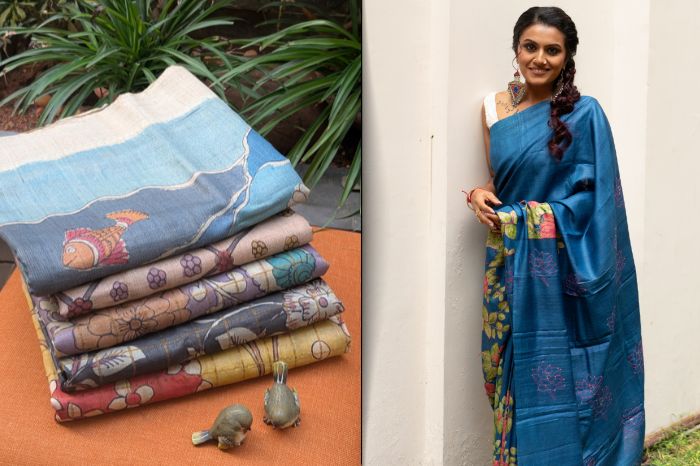

The Kalamkari art form is a beautiful representation of the creativity, craftsmanship, and heritage of Indian art on handloom. The Kalamkari artwork dates back nearly 3000 years, originating in the temple towns of Andhra Pradesh and Telangana. Who wouldn’t want to own a wearable piece of art and legacy?
Due to its popularity, many manufacturers try to mass-produce designs using chemical dyes and digital prints, reducing the authenticity of the artwork. This leaves artisans who make the effort to hand paint the unique artwork unrecognized.
As a customer, it can be challenging to distinguish genuine hand painted Kalamkari from many options flooding the market. In this guide, you can understand how to identify an original Kalamkari saree, what makes the craft so unique, and the traditional process that sets it apart.
What makes original Kalamkari sarees special?
Kalamkari art is a labour-intensive process involving the extraction of natural dyes, hand-drawing, hand-painting using the dyes, washing with right agents to get the colours right, and lots of patience while each layer dries in the sun. The entire process is drawn with a pen made from natural twigs from which it derives the name pen kalamkari. The elegance of the finished product is unmatched; it carries the soul of the artisan and the fruits of their labour. Each pen kalamkari saree is unique and contains a certain degree of variations in hand painting that further takes the artwork up a notch. There are 4 ways to identify pen Kalamkari sarees as explained below.
Checkout our Original kalamkari sarees, click here.
Understanding the process of hand painted Kalamkari sarees:
The process of producing a hand painted Kalamkari saree is truly a labour of love and patience. Understanding it helps appreciate what authenticity actually looks like. This is a brief introduction to what goes on in the workshop to produce authentic pieces that carry a centuries-old legacy.
Firstly, the fabric is prepared. Cotton, pattu, or tussar are treated with different combinations of milk and myrobalan and sun-dried. This facilitates retention of colour.

Secondly, the outlines of the design are hand-drawn using a pen or kalam, made from sharpening bamboo or other natural materials. Mythological scenes, delicate florals and vines, and God forms take form at this stage.

The colours are then filled using natural dyes derived from plant extracts. Each colour is applied separately, requiring multiple washes in between. The fabric at each stage is washed and sun-dried, which is a time-consuming process.

Finally, detailing is provided one last time using the pen or kalam, and at this stage, the art comes to life and the designs are highlighted perfectly.

Checkout our Kalamkari – The Art On Fabric With The Pen blog, click here.
Minor irregularities in the hand painted kalamkari design are common
Hand-painted Kalamkari silk sarees are unique due to the natural fabric base and of course, the hand-painting. No two sarees look exactly alike, simply because it is impossible to paint the same design in the same colour scheme in the same pattern, as a machine does.
While looking at a pen Kalamkari silk saree, you may notice slight variations in outlines, uneven brush strokes, small ink smudges, and slight differences in motifs in the sizes and shapes. These are not defects, but proof of the artisan’s hand. The human touch is visible in nearly every stroke, which the machine-made sarees cannot reproduce. The originality is accompanied by beautiful irregularities. Simply put no two motifs in a hand painted kalamkari sarees will look exactly identical.
Explore our curated Hand painted kalamkari silk sarees here

Colours are not uniform or similar in each pen kalamkari saree
In designer Kalamkari sarees or pen kalamkari pattu sarees, the inconsistency of genuine Kalamkari lies in the colours. The dyes are always extracted from naturally occurring substances such as indigo leaves, iron rust, hibiscus flowers, pomegranate peel and other vegetable dyes. There is also the factor in how these natural dyes react to the washing and sun-drying using different materials and different base colours of the fabric. The base material of the saree also plays a role in how the weave holds the colour, whether it is silk, cotton, or tussar and only pure handloom fabrics can hold hand painted kalamkari well.
This gives every Kalamkari piece a unique colouring, and no two pieces can be compared. This does not mean that the desired colours cannot be achieved. The tonal depth and earthiness of the colours are preserved during the painting process. However, synthetic prints do not have the same irregularities; they are too perfect and mass-produced, which deletes the authenticity of natural dyes.

A true identity mark: The fragrance of milk and myrobalan in a Srikalahasti kalamkari saree
The process of making a hand painted kanchi Kalamkari saree or a pen Kalamkari tussar silk saree begins with washing the fabric at every stage with cow milk and a natural occurring substance called myrobalan. This is done to preserve the natural colours used at each wash. Sun-drying between each wash also plays a role in how the colours develop.
Due to the multiple cycles of washing and drying, the fragrance of milk and myrobalan is faintly retained, resulting in an earthy scent that is one of the true markers of original Kalamkari, especially one that is fresh out of the workshop. Genuine pieces have an earthy scent, which serves as a reliable identifier.

Authentic kalamkari sarees use only natural colours
If a Kalamkari piece looks excessively bright, neon-toned, and unnaturally vibrant, it is highly likely not an original piece. Pen Kalamkari and hand-painted Kalamkari sarees utilize only natural dyes, creating earthy, warm tones.
The colours are rich but never loud, shades are warm, muted, and organic, and no fluorescent or overly saturated tones. This stands true regardless of which original Kalamkari saree you choose.
Click here: Explore our kalamkari kanchipuram silk sarees collection page

Final thoughts: Choosing an original hand painted Kalamkari saree
Authenticity doesn’t come from perfection, it comes from natural dyes, extensive handwork, and traditional, laborious processes.
While it is easier and cheaper to find mass-produced, digital-printed copies, the look and feel of an original Kalamkari and owning a piece as unique as you is satisfying to say the least! It is safe to say that every piece is a nod to the hardwork, dedication, creativity, and craftsmanship of every artisan.
Click here to explore our exclusive collection of original hand-painted kalamkari saree.
Check out youtube video of 10th Anniversary Event's Handpainted kalamkari workshop video here.

Explore the collection of original Kalamkari sarees, hand-painted Kalamkari sarees, Kanchi Kalamkari sarees, and tussar silk Kalamkari sarees at https://thesstudioonline.com/. Own a piece of legacy today!